

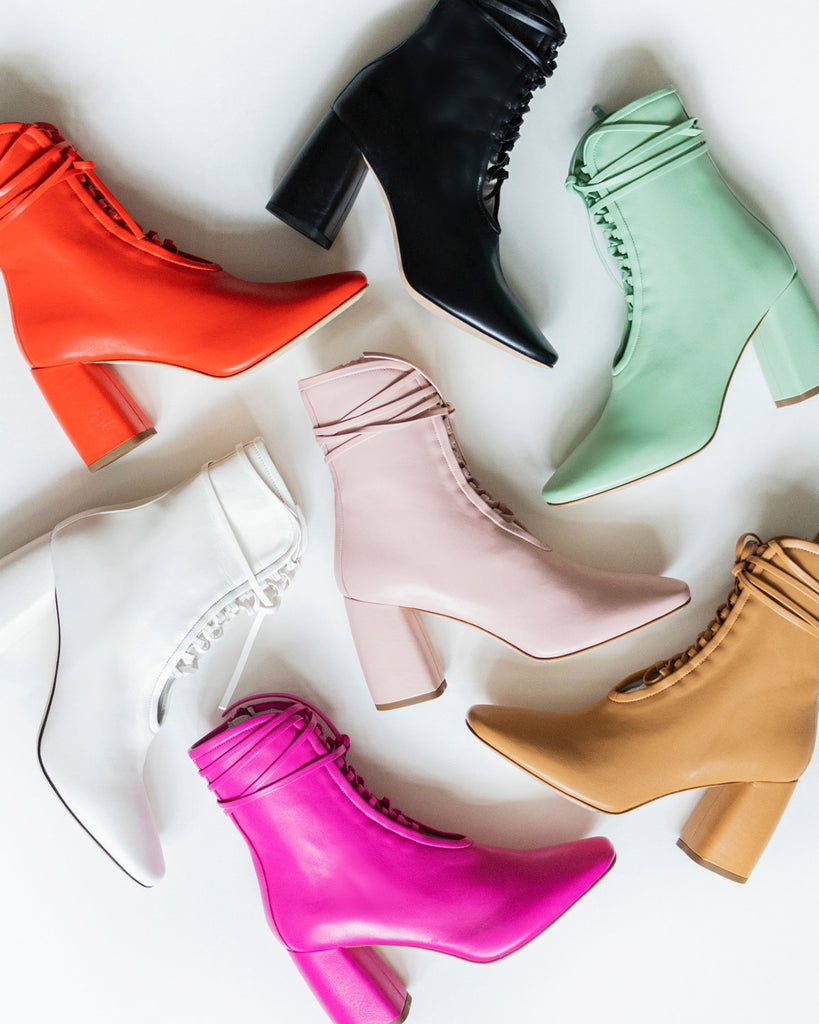


Comfortable pointed toe heels do exist, but they only work when the shape is engineered from the inside out. The most wearable pairs usually sit in the 3 to 5 cm comfort zone, and clinical literature notes that 4 cm produced a more stable center of pressure than 0.5 cm or 9 cm in one study, which tells you comfort is about balance, not just height.
You're probably here because you love the line of a pointed pump, a slingback, or a sharp little bootie, but you're tired of the familiar bargain: beautiful shoes now, aching feet later. I've designed for that exact woman for years.
I've also spent enough time in Italian and Portuguese factories to know that a pointed toe is one of the hardest silhouettes to get right. It can look refined and still fail your feet in minutes if the last is wrong, the pitch is too aggressive, or the leather is beautiful but unforgiving.
My view has never changed. Luxury should never be painful. If a shoe needs a backup flat in your tote, it isn't finished.
The End of the 'Backup Flats' Era
I know the ritual. You buy the gorgeous pointed heels for a presentation, a wedding, or a dinner you've been looking forward to all week. You leave the house feeling polished, then by the second hour you're negotiating with your own feet.
That old habit of carrying emergency flats didn't appear by accident. Women learned to plan around discomfort because so many pointed styles were drawn to look elegant on a shelf, not to move through a real day.

When I speak with clients, the frustration is rarely about fashion. It's about interruption. Pain changes how you walk, how long you stay, how confidently you stand in a room, and whether you keep saying yes to the plans you wanted to enjoy.
What women want now
Today's pointed heel has to do more than look sleek. It has to work for:
- Commuting: Getting from car to office, train to meeting, lobby to dinner.
- Event dressing: Standing, circulating, dancing, and not counting the minutes until you can sit.
- Day-to-night versatility: One pair that can carry a schedule, not just complete an outfit.
That shift is exactly why comfort-first luxury has become more interesting than extreme footwear. A beautiful silhouette is still the starting point. It just can't be the whole story.
Practical rule: If a pointed heel feels good only when you're standing still, it's not actually comfortable.
I often think of pointed-toe design as a promise. The promise is polish. The question is whether the shoe can keep it once you start moving. That's why I care so much about shape, flex, padding, and fit security long before a final sample is approved.
If you dress for work often, my guide to office shoes for women goes deeper into what makes a polished shoe wearable through a full schedule.
Why Do Most Pointed Toe Heels Hurt
The blunt answer is that most pointed heels ask your foot to do two difficult things at once. They push weight forward, then narrow the space where that weight lands.
A 2023 clinical review notes that high-heeled, particularly pointy-toed shoes can structurally distort and overload the feet, and that pointed shoes are associated with corns, lesser-toe deformities, hallux valgus, metatarsalgia, and neuroma, sometimes severely enough to require surgery. The same review also notes that heel heights around 3.76 to 4.47 cm are often cited as a more suitable comfort range, with 3 to 5 cm described as the optimal zone for balance and stability, and that 4 cm created a more stable center of pressure than 0.5 cm or 9 cm in one study, as summarized in this National Library of Medicine review on high heels and foot health.

The toe box is usually the real culprit
Many women assume heel pain starts with heel height alone. In pointed styles, that's only part of the story.
The bigger issue is often the tapered toe box. When the front narrows too quickly, your toes can't rest naturally. They crowd, overlap, and brace. That pressure builds fast when you're walking, not just standing.
Here's what usually goes wrong:
- Too much taper too soon: The shoe narrows before the toes have enough width.
- A rigid upper: The material doesn't relax where the foot needs a little accommodation.
- Forward slide: The foot slips toward the front, increasing pressure exactly where the shoe is smallest.
Pitch changes everything
As a designer, I pay close attention to pitch, meaning the angle your foot sits at inside the shoe. Two heels can look similar in height and feel completely different because one places the foot on a calmer incline.
A steep pitch loads the forefoot quickly. Add a pointed shape and now the ball of the foot and the toes are both taking punishment.
The sleekest pointed shoe in the room can still be the worst-engineered one.
This is why I'm skeptical of shoes marketed as comfortable because they have a padded insole. Cushion helps, but it doesn't fix poor geometry. If the last, pitch, and front shape are wrong, extra foam becomes a bandage, not a solution.
If you've struggled with very slim silhouettes, my thoughts on women's narrow dress shoes may help you spot the difference between a refined fit and a punishing one.
The Secrets of Comfort First Design
The first thing I check in a pointed heel sample is whether the shape is honest. A shoe can look refined on the shelf and still be built on a last that forces the foot into a position it cannot hold for long. Comfort starts much earlier than padding. It starts in the proportions.

What I look at first in a sample
When a prototype arrives, I study the last, the topline, and where the shoe bends before I even put it on. If the architecture is wrong, a soft insole will only hide the problem for a few minutes.
My checklist is practical:
- A point with usable space inside: The silhouette should taper visually at the end, not collapse the area where the toes sit.
- A calmer pitch: Heel height matters, but distribution matters more. The foot should not be pushed so far forward that the forefoot does all the work.
- A secure upper: Slingbacks, a slightly higher vamp, or a well-cut topline help keep the foot from sliding and reduce heel lift.
- Flex placed under the natural bend of the foot: If the sole breaks in the wrong spot, the shoe fights your stride.
- Targeted cushioning: Padding should sit where pressure builds, especially under the ball of the foot, instead of being added everywhere for showroom softness.
I learned this the hard way early in development. I once reviewed a beautiful sample with a razor-sharp toe and a plush sock lining. It felt impressive in hand. On foot, the toe spring was too stiff, the vamp cut too low, and the foot migrated forward after a short walk. We changed the last, adjusted the topline, and reduced the pitch before discussing extra foam.
The difference between styled comfort and engineered comfort
Comfort-first design has to be decided before the upper is cut. That means choosing a last with enough width at the ball, shaping the toe box so the taper begins later, and building stability into the pattern. Those choices are less visible in a product photo, but they are exactly what determine whether a pointed heel feels poised or punishing after an hour.
I also pay close attention to how the shoe holds the foot through motion. A pointed heel should not require constant toe gripping to stay on. If a woman has to claw at the insole while she walks, the fit is already failing. Good engineering creates hold through pattern and balance, not tension.
A good pointed heel should feel locked in, not strapped on and hoped for.
Construction quality matters here because small decisions change the whole experience. Skiving, lining selection, lasting precision, and how the insole layers are built all affect pressure, friction, and stability. I wrote more about those details in this piece on handcrafted women's shoes.
For a concrete example, Daniella Shevel designs styles like NOLA, ISABELLA, CLEO, and ROMI around this comfort-first framework, using handcrafted construction and a multi-part cushioned insole system rather than relying on appearance alone.
Materials Make the Masterpiece
A pointed heel can be beautifully balanced on the last and still fail on the foot if the materials are wrong. I learned that early in development. Two prototypes can share the same pattern and heel height, yet wear completely differently once heat, movement, and pressure enter the picture.
From a shoemaker's point of view, material choice changes how the shoe behaves over hours, not just how it looks in a photo. A stiff high-shine leather can hold a sharp silhouette, but in a pointed shape it often resists the foot exactly where women need a little forgiveness. A supple nappa or a well-finished suede gives more naturally at the joints, recovers better after wear, and usually creates less friction at the forefoot.
What I choose, and why
I build pointed heels with materials that can keep their line without turning rigid at the pressure points. That usually means:
- Supple leather: It conforms more gently over the ball of the foot and tends to break in with less rubbing.
- Soft suede: It offers a refined look while feeling less restrictive through the toe area.
- Stretch panels or stretch leather: Useful for bunions, slight asymmetry, or feet that swell over a long day.
- Smooth leather linings: They reduce drag inside the shoe, which matters in a silhouette where even minor rubbing becomes noticeable fast.
Patent still has its place. I use it selectively because it delivers polish and structure, but it is less forgiving in a pointed toe and less breathable in extended wear. That trade-off matters.
Material selection also affects what happens inside the shoe. If the upper has no flexibility, the foot takes the load. If the lining is coarse or the seam allowance is bulky, the wearer feels it almost immediately near the toes and along the sides. That is why I care so much about skiving, seam placement, and how cleanly the upper is lasted. Those details decide whether the shoe feels refined at hour six, not just minute six.
I wrote more about that relationship between leather quality, hand-finishing, and wear in this guide to handcrafted Italian leather shoes.
Why factory technique matters as much as the hide
When I visit our factories, I am not only checking color and finish. I press the upper with my thumb to feel its memory. I look at how thinly the leather has been skived near the topline. I run a finger inside the toe to make sure the lining lies flat and the seam does not create a ridge. In a pointed heel, a millimeter too much bulk can change the whole experience.
That is also why small-batch production works better for this category. It gives the maker time to adjust material pairing, refine the lasting, and reject a beautiful leather if it is too stiff for the shape. Luxury should feel considered on the inside.
For women who prefer lighter, more breathable pointed styles, ROMI reflects that approach. If you want a lower profile with a polished finish for longer wear, the CLEO collection is a useful reference point.
Finding Your Perfect Fit and Break In Period
You know the feeling. You put on a pointed heel at 7 a.m., it feels fine in the mirror, and by lunch you are shifting your weight, slipping the shoe off under the table, and planning the walk back to the car. In my experience, that usually starts with fit, not heel height alone.
Pointed shoes leave less room for error because the silhouette is visually long while the wearable space is not. A few millimeters too short, too shallow, or too tapered at the wrong point can push the foot forward, crowd the toes, and make you grip to stay balanced. That is why I fit pointed styles more critically than almost any other category we make.
How to judge fit in a pointed heel
Always test fit standing and walking. Sitting hides pressure, and pointed shoes reveal themselves once your full weight drops into the forefoot.
Here is what I check first:
- Your toes should rest flat: They can taper gently, but they should not overlap, curl, or feel compressed at the tip.
- Your heel should feel secure: Slight movement can happen in a new shoe, but repeated slipping means the last is not matching your foot properly.
- The ball of your foot should sit at the shoe's flex point: If it lands too far forward or back, the shoe will fight your stride.
- The vamp should hold without cutting in: Good support comes from shape and placement, not brute tightness.
I also pay close attention to where the point begins. A pointed toe can look sharp on the outside and still be wearable inside if the toe box tapers later and the last gives the toes more lateral room. That is one of those details customers do not always see immediately, but they feel it within an hour.
Break-in should feel like the shoe learning your foot, not your foot surviving the shoe.
What a real break-in period should feel like
A well-made pointed heel should soften and become more familiar over the first few wears. You may notice the upper flexing more naturally, the topline settling, and the shoe moving with your stride instead of against it. You should not be dealing with numbness, pinching that gets worse, or a pressure point you can identify within minutes.
Leather can ease. Structure does not magically change.
That distinction matters. If the length is wrong, the pitch throws you forward, or the toe box shape conflicts with your foot, no break-in period will solve it. In my fittings, I would much rather move a woman into the correct size or width than ask her to hope the shoe improves.
If you are between sizes or unsure about width, start with a measuring tape and a real fitting method. This guide on how to measure shoe size and width will give you a much better starting point than guessing from what you wear in sneakers. If you are trying shoes on in person, do it later in the day when your feet reflect normal swelling and walking.
Small adjustments can help once the foundation is right. A cobbler can stretch a tight spot, place padding with precision, or adjust fit at the heel so the shoe works with your foot instead of asking your foot to compensate. That is the kind of break-in I believe in. Refined, specific, and based on construction, not endurance.
Day to Night Styling for Any Occasion
You leave home in a trouser suit at 8 a.m. and end the night at dinner without once thinking about your feet. That is the standard I design toward.
A pointed heel earns its place when it works across a full day, not just the first twenty minutes. The shape brings precision to an outfit. It sharpens soft fabrics, cleans up denim, and gives evening clothes definition without adding bulk.

Three ways I style them most often
I build shoes with this kind of range in mind, so styling starts with function. For the office, I prefer a pointed pump with clean trousers, a fluid midi skirt, or a column dress. The line looks polished, and the shoe does not have to fight the clothing for attention.
For travel or long city days, I reach for a lower heel or a pointed boot with real support through the waist of the shoe. Straight-leg denim, a fine knit, and an oversized blazer usually do the job. The look is composed, but it still lets you move.
Evening is where many women assume they need a higher heel. I usually disagree. A well-balanced mid heel with a refined point often looks better and feels far better after several hours on your feet. In design meetings, I pay close attention to that trade-off. Height can add drama, but proportion and stability are what make a shoe wearable after dark.
These are the combinations I come back to most:
- Boardroom: A pointed pump, full-length trousers, and a long coat.
- Dinner after work: The same heel with a silk skirt or dark denim and bold jewelry.
- Event dressing: A pointed slingback or lower heel with a dress that moves easily.
- Weekend polish: A pointed ankle boot and cropped jeans.
The wedding guest edit is a practical place to start if you need an event pair you will wear more than once.
Quiet luxury works hardest when it's wearable
The women I design for are not dressing for a single photo or a short car-to-table evening. They are walking on pavement, standing in lobbies, taking meetings, and staying out longer than expected. A beautiful shoe should support that reality.
I learned early on that versatility begins at the pattern table. If the toe line is too severe, the shoe looks elegant sitting still but becomes limiting in real life. If the heel is too delicate, it may photograph well and feel unstable on a city sidewalk. The best day-to-night pairs strike a harder balance. They look refined, but they are built for movement.
If you want to see how movement changes the feel of a heel, watch this:
In our collection, I often point women toward silhouettes based on wardrobe habits rather than trends. A mesh bootie suits someone who wants breathability and a sharper, more directional line. A classic pump or slingback makes more sense for a wardrobe built around tailoring, dresses, and repeat event dressing. The right choice is usually the one that disappears into your routine while still making the outfit feel finished.
Written by Daniella Shevel, Designer & Founder
If you're ready to stop planning outfits around pain, explore the latest handcrafted options and find your pair for work, weddings, and everything in between.