

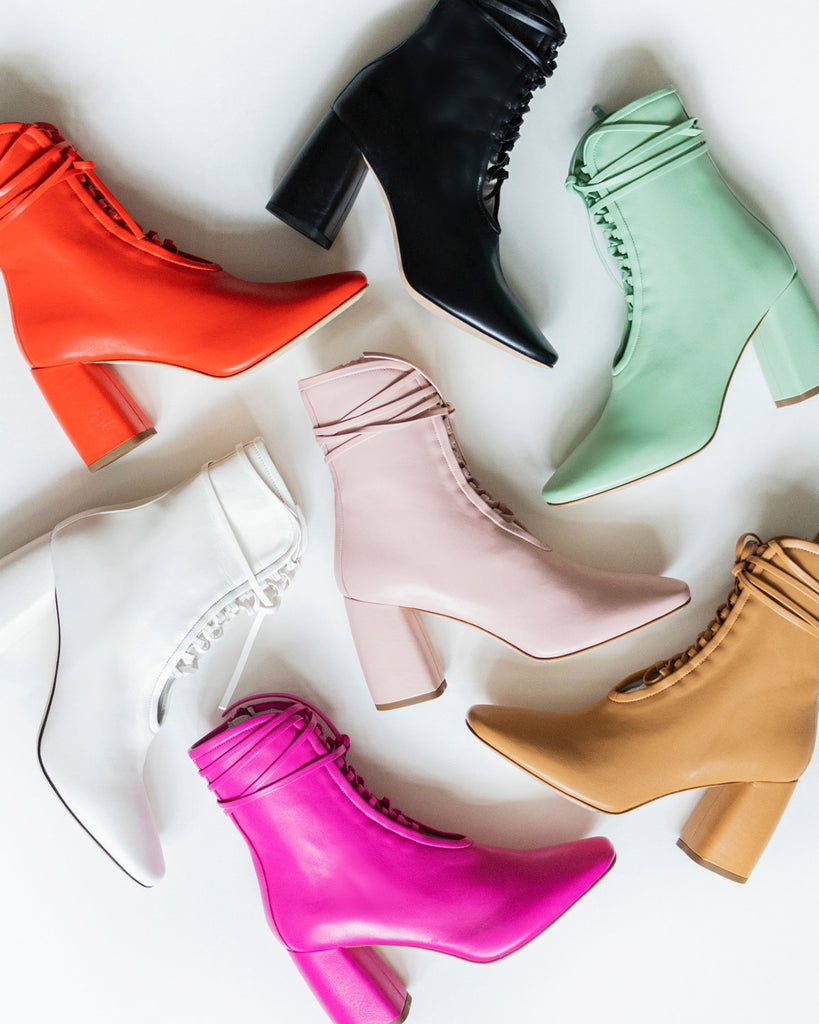


The best boots for walking all day combine three essentials: a cushioned insole that cradles the foot, a shape that distributes weight properly, and soft materials that adapt instead of fight you. To earn that label, a boot also needs to stay comfortable through 10,000 steps, roughly 4 to 5 miles, which is the kind of repeated city walking that exposes every flaw in fit, heel slip, and forefoot pressure.
You know the moment. You're packing for a trip, or dressing for a day that starts with a commute and ends at dinner, and the question isn't what looks good. It's what still feels good hours later.
Most women have been taught to accept a false choice. You can have polished boots, or you can have comfort. In practice, the best boots for walking all day are the pairs that were designed from the beginning for city life, not just for a quick try-on in front of a mirror.
Your Search for the Perfect Walking Boot Ends Here
A beautiful boot can feel promising at 8 a.m. and punishing by noon. That usually happens because the design brief prioritized silhouette first and real wear second.
I've always believed luxury shouldn't ask you to suffer for it. A boot that works for a museum day, a full calendar of meetings, or a travel day with uneven sidewalks has to perform differently from a boot made only to look elegant while standing still.

What actually makes a boot walkable
Three things separate a wearable fashion boot from one you'll regret:
- Cushioning that lasts: Not a soft first impression that collapses quickly, but underfoot comfort that keeps protecting the foot over hours.
- Weight distribution: The foot shouldn't be shoved forward or forced to grip with the toes all day.
- Materials that yield: Good leather should soften around you, not pinch at the flex point.
Those sound simple, but most disappointing boots fail on at least one of them.
The right boot disappears into your day. The wrong one keeps introducing itself every twenty minutes.
A lot of generic shopping advice also blurs together hiking boots, travel shoes, and sleek ankle boots. That's why I often point women to a more focused conversation around comfortable boots for women, where the key question isn't just “Is this comfortable?” but “Comfortable for what kind of day?”
The city test matters more than the fitting-room test
A fitting room rewards first impressions. Real life rewards engineering.
The pair you'll reach for again and again is the one that can handle hard pavement, long transitions between neighborhoods, standing between appointments, and the little extra distance that always sneaks into a day. That's the standard worth shopping for.
The Anatomy of an All-Day Walking Boot
You feel the difference around step 2,000. The boot that looked polished in the mirror starts rubbing at the heel, your forefoot gets tired, and you begin adjusting your stride without noticing. A walkable luxury boot is built to prevent that chain reaction.
For a boot to handle a full day on foot, every structural choice has to work together. The sole manages impact. The pitch controls where your weight lands. The upper holds the foot in place without creating pressure. If one part is off, the whole boot feels harder to wear.
For a boot to be walk-all-day capable, it has to handle the kind of mileage many women expect from travel days, long city walks, and full commutes, as noted in Blundstone's guide to boots for walking Europe travel. Repetition exposes weak design quickly.

Start with the base
The sole does more than add height or finish the silhouette. It sets the rhythm of the walk.
What I look for first is controlled flexibility. A boot should bend where the foot bends, then stay stable through the rest of the stride. Too stiff, and the gait turns clunky. Too soft, and the foot works overtime trying to create its own support.
A strong base usually includes:
- A midsole with some give: Enough movement for a natural stride, without collapsing under repeated wear.
- An outsole with stable ground contact: Grip matters, but so does predictable footing on pavement, stairs, and slick indoor floors.
- Impact control: Hard city surfaces punish thin or rigid constructions faster than shoppers expect.
What tends to fail in fashion-first boots is just as predictable:
- Footbeds that feel hard and flat under pressure
- Heavy soles that add weight without improving balance
- Outsoles that look substantial but interrupt a smooth step
Pitch decides whether your feet can settle
Pitch is one of the least discussed comfort factors and one of the most important. It is the relationship between heel height and forefoot height, and it determines whether your weight stays centered or keeps sliding forward.
When pitch is balanced well, the foot can rest inside the boot. When it is too aggressive, the toes start gripping, the ball of the foot takes extra load, and the calf never fully relaxes. In design, a beautiful profile still has to respect that geometry.
I spend a lot of time on this point because women often blame the wrong thing. They assume they need more padding, when the primary problem is that the boot is tipping them forward all day.
Cushioning should keep its shape under miles
Softness is easy to sell. Lasting support is harder to build.
A plush insole can feel wonderful for five minutes and disappoint by lunchtime if the material compresses too quickly. The better standard is resilient cushioning that rebounds after repeated impact and works with the structure underneath it. In a refined walking boot, comfort comes from the full system, not from one pillowy layer hidden inside.
For women who split time between urban travel and occasional outdoor days, it also helps to separate needs clearly. If you are planning actual trail mileage, a dedicated resource like these best US hiking trails can help you assess terrain before deciding whether you need true hiking footwear rather than a city-ready boot.
The upper should guide the foot, not trap it
The upper is where fit, movement, and appearance meet. This is also where many attractive boots fall apart in real life.
A well-designed upper should do three things at once:
- Hold the heel securely: Less slipping means less friction.
- Leave enough room through the toe box: Feet spread with hours of walking.
- Flex at the correct points: The boot should move with the foot at the vamp and ankle.
This is why shape matters as much as softness. Even beautiful leather will not save a boot built on the wrong last. If you are unsure whether discomfort is coming from length or width, this guide on how to measure shoe size and width accurately at home will help you diagnose the issue before you buy.
The best all-day walking boots do not rely on one comfort feature. They succeed because the sole, pitch, cushioning, and upper are working in balance. That is the difference between a boot that photographs well and one you still want on your feet at dinner.
Why Do Materials and Craftsmanship Matter So Much
A boot can have the right silhouette and still fail by lunchtime if the materials are wrong. I see it often. The leather looks beautiful in the box, but it is board-stiff across the flex point, the lining runs hot, or the finishing inside the boot creates small points of friction that turn into real discomfort after a few city miles.
As a designer, I pay for materials that solve problems before the boot ever reaches your closet. That means leather with enough body to hold a refined shape, but enough give to move with the foot. It means linings that feel smooth against the skin and construction that stays consistent from pair to pair.
Soft leather is a comfort tool
Luxury leather matters because of how it behaves under motion. A good upper should relax over time, not collapse. It should bend where the foot bends, soften around pressure areas, and keep its appearance after a long day on concrete.
That balance is harder to achieve than people realize.
When I review hides in Italy and Portugal, I am checking for more than color and finish. I look at spring, grain, and recovery. If a leather creases harshly, fights the foot at the vamp, or feels dry in the hand, it will rarely become a boot you want to walk in for hours.
For readers weighing quality against price, this guide to Italian leather boots for women explains why better leather usually wears better, feels better, and lasts longer.
Craftsmanship is what makes comfort repeatable
Material quality alone is not enough. Craftsmanship determines whether that leather is cut, joined, lined, and finished in a way that supports all-day wear.
Small production runs help because the details get more attention:
- Cleaner seam placement: Poorly placed seams create rubbing long before a sole wears out.
- More consistent panel selection: One stiff section of leather can change how the entire boot flexes.
- Better internal finishing: Smooth linings and tidy edges matter when a boot is on your foot for ten thousand steps.
These are quiet details, but the foot notices every one of them.
I care about this because comfort in a luxury boot should never come at the cost of shape. The goal is not to make a fashion boot feel like a sneaker; it is more disciplined than that. Build structure where the foot needs support, remove bulk where friction starts, and choose materials that age with grace instead of becoming brittle or misshapen.
Better materials do not just age beautifully. They move beautifully, too.
Style holds up better when the construction is restrained
The most useful walking boots for city life usually share the same design discipline. Clean lines. Thoughtful heel placement. Enough presence to feel polished, without the heaviness that makes a boot tiring by mid-afternoon.
That usually looks like:
- Minimal hardware that does not add weight or stiffness
- Leathers and suedes with shape retention, but not hardness
- Heels that create posture and polish without tipping the foot too far forward
Among current options, Daniella Shevel approaches this through handcrafted construction, glove-fit shaping, and memory foam cushioning in styles designed for long city wear rather than trail use. For women who want one pair to handle commutes, travel days, and dinner plans, those choices make the difference between a boot that is only attractive and one that keeps earning its place in the wardrobe.
Solving for Fit Finding Your Perfect Pair
The most overlooked truth in footwear is that comfort isn't just about padding. It's about fit.
Women are more likely than men to report foot pain and to wear ill-fitting shoes, which is why shape-specific design matters so much, as noted in this discussion of fit, foot pain, and women's footwear issues. If a boot doesn't suit your foot shape, extra cushioning won't rescue it.

If you have a wider forefoot or bunions
Many luxury boots fail first because a narrow, tapered front, while looking elegant on a shelf, can become punishing within an hour.
Look for:
- A more forgiving toe shape: The front should allow the foot to rest naturally.
- Softer uppers or stretch panels: These help the boot adapt instead of creating a hard pressure point.
- Less internal bulk: Thick seams at the forefoot often create avoidable irritation.
If this is your challenge, measuring properly matters more than guessing. A useful starting point is this guide on how to measure shoe size and width, especially if you've been buying the same labeled size for years without checking your actual width.
If you have narrow heels
Heel slip is one of the fastest ways to ruin a boot. It creates friction, makes your gait inefficient, and often causes you to tense your toes to stabilize yourself.
A better fit usually comes from:
| Fit issue | What helps |
|---|---|
| Heel lifting | A snug heel counter and secure instep hold |
| Sliding forward | Balanced pitch and a stable footbed |
| Ankle rubbing | Soft collar materials and smoother interior finishing |
Narrow-heeled women often think they need a smaller size. Usually they need a different shape.
If you need arch support or fatigue relief
Foot fatigue often shows up as a vague ache rather than one obvious sore spot. That usually points to lack of support, poor pressure distribution, or both.
Here's what to pay attention to during a try-on:
- The arch should feel held, not poked: Support should feel integrated into the footbed.
- Your forefoot shouldn't burn: Burning often means too much load is landing at the front.
- You shouldn't brace while standing still: If you are, the structure is off.
A good fit feels quieter than a bad one. Your foot relaxes instead of negotiating.
For women shopping in person, personalized fitting makes a real difference. A knowledgeable fitter can often spot the mismatch between your foot shape and the boot's last within minutes, long before you discover it halfway through the day.
From Cobblestones to Commutes Styling Your Boots
Most articles treat all walking boots as one category. That's not how women wear them.
City boots need a different balance. They should feel polished enough for an office or a dinner reservation, while still giving you the nimbleness and protection needed for a full day on your feet, as observed in Stridewise's look at boots for travel.

The global jet-setter
If your day includes airport floors, old stone streets, and a dinner booking, a sleek ankle boot is often the smartest packer's choice. It gives more coverage than a pump, more refinement than a sneaker, and enough structure for long walking days.
What tends to work best:
- Low or mid block heels: They add polish without making the foot work harder.
- Soft leather uppers: Better for long sightseeing days when feet start to swell.
- Sleek shafts: Easier with trousers, denim, or midi skirts.
If your travel wardrobe leans monochrome and sleek, a style direction similar to the looks in this edit of flat black leather boots is often the easiest anchor.
The no-backup-flats executive
This woman doesn't want to change shoes in a taxi. She needs one pair that can carry her from pavement to presentation to dinner.
The strongest outfit formulas are usually simple:
- With tailoring: A clean ankle boot under full-length trousers creates a long line and hides comfort engineering well.
- With dresses: A refined boot keeps a work look grounded and practical.
- With dark denim: It solves the office-to-evening transition with almost no effort.
A style like CLEO works because it doesn't read “comfort shoe.” It reads intentional.
Here's a closer visual reference for how that balance can look in motion:
The all-day event guest
An event shoe has to survive standing, greeting, walking, and lingering. The mistake most women make is choosing for the first fifteen minutes instead of the full arc of the occasion.
For an all-day event, I'd prioritize:
- A secure heel fit
- Enough forefoot room to avoid late-day compression
- A shape that still feels elegant with dresses and eveningwear
The chicest event shoe is the one you're still happy to be in when everyone else has kicked theirs off under the table.
That's the difference between a boot that photographs well and a boot that effectively serves your life.
A Lasting Investment Care and Sustainability
The best boots for walking all day shouldn't be impulse purchases. They should become part of your regular rotation for years.
That's where the market has shifted. REI's 2026 boot testing describes the strongest modern options as balancing “burly protection and nimbleness” in its expert advice on hiking boots. Even outside hiking, that phrase captures what women now want from city boots too. Not single-purpose gear, but versatile pieces worth keeping.
How to protect a beautiful boot
Luxury materials age well when you treat them well. They don't respond kindly to neglect.
A practical care rhythm looks like this:
- Brush off city dirt early: Grit can dry out leather and dull suede.
- Let boots rest between wears: Materials recover better when they aren't worn hard day after day.
- Use shoe trees or light stuffing: This helps preserve shape at the toe and vamp.
- Address fit issues promptly: A small stretch or adjustment early can prevent long-term discomfort.
For women thinking more broadly about longevity and wardrobe choices, this guide to what is sustainable fashion is a useful companion read. Sustainable luxury starts with buying pieces you'll keep wearing.
Repair is part of the value
A well-made boot is often worth maintaining. Resoling, stretching, and small repairs can extend the life of a favorite pair and preserve the fit you've already broken in.
That matters because all-day comfort is cumulative. Once a boot has adapted to your foot in the right way, it becomes much more valuable than a new replacement that still needs to prove itself.
Buy fewer, wear better
That's the core investment mindset. Not owning more boots, but owning the right ones.
Handcrafted production, thoughtful materials, repairability, and circular programs all support that idea. A beautiful boot earns its place when it keeps showing up for the life you live.
If you're ready to find a pair that can handle long walks, full workdays, and evening plans without sacrificing style, explore Daniella Shevel and shop for a boot that's designed to be worn, not merely admired.
Written by Daniella Shevel, Designer & Founder