

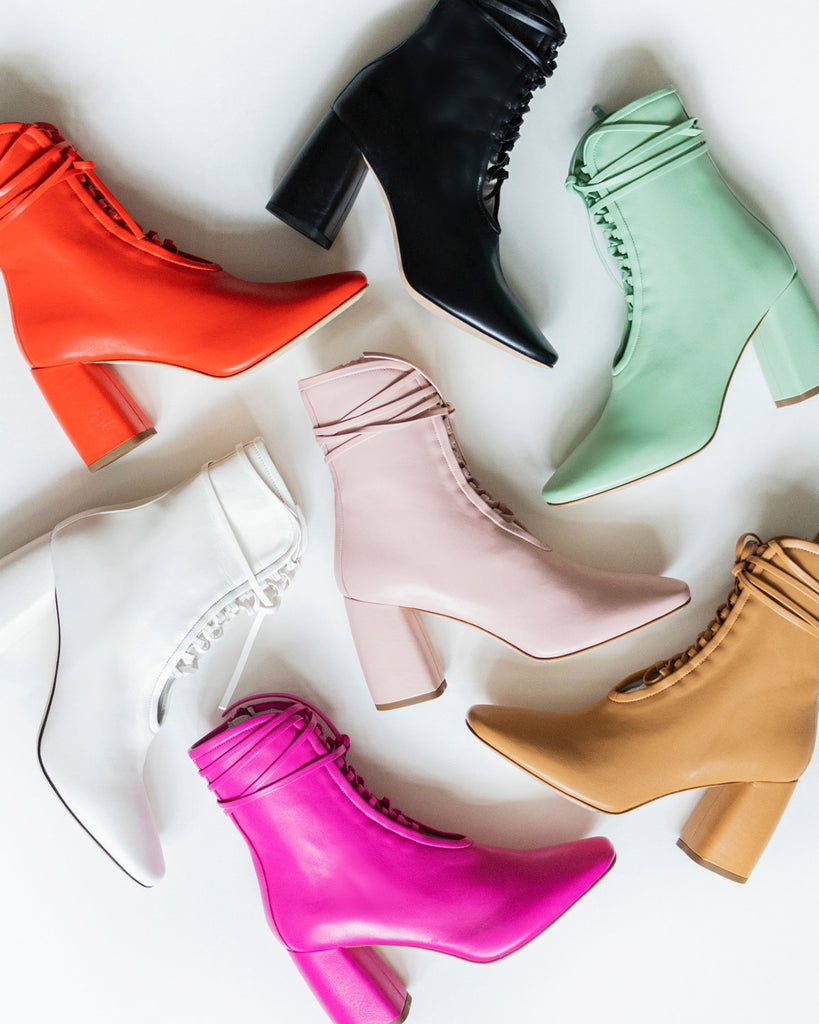


Slow fashion is a response to an industry that produces roughly 100 billion garments annually and generates about 92 million tonnes of textile waste per year. It means choosing quality craftsmanship, timeless design, and ethical production over disposable trend cycles.
I learned this the same way many women do. Through a pair of beautiful shoes that looked right in the box, pinched by noon, scuffed by evening, and felt tired long before I did.
An Introduction to Conscious Luxury
A woman once came into our store carrying her heels in one hand and her dignity in the other. She had walked out of a meeting in Midtown, crossed three blocks in bare feet, and said, “I'm done buying shoes for the photo and suffering through the day.”
That sentence has stayed with me.
For me, what is slow fashion becomes very simple in moments like that. It's a more thoughtful way to dress. You buy with intention, you look for pieces that can live many lives, and you expect beauty to be supported by function.

Why the idea feels so personal
I've always believed luxury should not be painful. Not for your feet, not for your closet, and not for the people who make what we wear.
When I sketch a shoe, I'm not thinking about a single dinner reservation. I'm thinking about the woman who leaves home at eight, walks city blocks, takes meetings, stays out for drinks, and wants one pair to carry her through. That's where comfort-first design, handcrafted construction, and day-to-night versatility stop being marketing language and start becoming a philosophy.
I don't think slow fashion asks you to give something up. I think it asks you to expect more from what you bring into your life.
The same logic exists in other crafts. If you've ever been curious about the difference between made-for-now and made-with-care, this thoughtful explainer on what is bespoke tailoring captures that beautifully from another angle.
Slow fashion is an upgrade, not a compromise
People often assume slow fashion is about restraint. I see it as refinement.
It means asking better questions:
- Will I still want this next year when the trend cycle has moved on?
- Can I wear it often without discomfort?
- Was it made with enough care that repair, resoling, or stretching are worth doing?
If you want a broader look at how mindful wardrobe building fits into a modern luxury closet, I love continuing the conversation in our piece on what sustainable fashion means in practice.
In that sense, slow fashion isn't austere at all. It's sensual leather that softens with wear. It's a pointed boot that looks sharp in the office but still feels civilized at dinner. It's buying fewer things and enjoying them more fully.
The Hidden Cost of Fast Fashion
Fast fashion trained us to judge clothing by the first impression. The price tag. The color. The trend hit. The speed of delivery.
The actual cost shows up later. In closets full of almost-right purchases. In soles that separate too soon. In materials that can't keep their shape. And on a much larger scale, in a system built around constant output and constant disposal.
Slow fashion emerged as a response to an industry that emits about 10% of global annual carbon emissions and generates roughly 92 million tonnes of textile waste per year, with most of that waste ending up in landfills or incinerators, according to these fast fashion industry figures.

The system rewards speed, not staying power
When brands are built around relentless newness, durability becomes less important. So does repairability. So does emotional attachment.
That's why so many women have had the same experience: a purchase feels exciting for a week, acceptable for a month, and irrelevant by next season. The item didn't fail because you styled it wrong. It was often designed for a short life from the beginning.
A useful way to think about this is through inheritance. The pieces we treasure are rarely the fastest-made ones. They're the blanket passed down through a family, the coat that still holds its shape, the shoe you resole because it's worth saving. That same mindset appears in this lovely guide to building legacy gifts, where longevity matters more than novelty.
Waste starts long before you throw something away
The hidden cost isn't only what happens after a garment leaves your closet. It begins at production.
The global fast fashion industry is valued at approximately $150.8 billion and produces roughly 100 billion garments annually, while fashion circularity still accounts for only about 3.5% of the global market today, with a projection of 23% by 2030 in a more circular scenario, as outlined in these sustainable fashion market statistics.
That gap tells a story. We're producing at extraordinary volume, while only a small portion of the system is built around reuse, resale, repair, and recycling.
If you want to see how the opposite model works on the ground, our thoughts on small-batch handmade Italian shoes show why slower production changes the entire relationship between design and waste.
The most expensive shoe is often the one you replace three times.
What moves me about slow fashion is that it restores consequence to design. It asks makers to think beyond the launch and asks shoppers to think beyond the checkout.
What Are the Principles of Slow Fashion
I don't think of slow fashion as a mood board. I think of it as a set of habits, both for the designer and the customer.
The principles are elegant because they're practical. They help you buy with more confidence and regret far less.
Buy less, but expect more
This is the heart of it. Fewer purchases, chosen with more care.
That doesn't mean owning only basics or giving up personality. It means every piece should have a reason to exist in your wardrobe. A pointed boot should work for the office and dinner. A sandal should feel as relevant on vacation as it does in the city.
Prefer cadence over churn
Fast fashion runs on constant drops. Slow fashion works differently.
According to EBSCO's overview of slow fashion, slow fashion brands often limit new collections to one or two per year, operating with 10 to 25 SKUs per season versus 200 to 500+ for fast fashion chains. That smaller model can reduce collection-level overproduction waste by 30 to 50%.
That's a technical point, but it matters. Smaller runs force discipline. They ask a brand to refine instead of flood.
Choose design that survives trend fatigue
A slow fashion piece should still feel desirable when the algorithm has moved on.
Here's what that usually looks like:
- A stable silhouette that doesn't depend on a micro-trend to feel current
- A restrained palette that works with what you already own
- Real versatility so you can style one item many ways
For readers who want to see how handwork affects wear, shape, and feel, our journal on handcrafted women's shoes goes deeper into what that looks like in footwear.
Value transparency and aftercare
A brand can say “slow” all day long. The better question is whether you can see it.
Look for signs like:
- Smaller collections instead of weekly novelty
- Disclosed factory locations and clear production stories
- Repair support or stretching services
- Take-back or donation programs that extend product life
A slow fashion purchase should feel more legible. You should be able to understand why it was made, how it was made, and how to keep it going.
That's why I always encourage women to shop with curiosity, not just desire. The right pair should answer questions, not create them.
How to Evaluate Slow Fashion Footwear
I can usually tell within a minute whether a shoe was made to be lived in or merely photographed. You feel it when you pick it up. The upper has body. The sole meets the shoe cleanly. The lining feels considered against the skin instead of like an afterthought. In footwear, those small signals matter because a shoe is tested immediately. It has to support you, soften impact, and keep its shape while you move through a real day.
That is why I always start with construction before I look at styling.
Start with materials and structure
I look at the upper first, then the lining, then the place where the sole is attached. If those fundamentals are weak, no beautiful silhouette can save the shoe for long. Slow fashion in footwear is very physical. You can see it in even stitching around pressure points, in leather or textile that feels supple instead of plasticky, and in a shape that does not collapse after a few wears.
Analysts who study clothing life cycles consistently find that wearing a product longer lowers its impact per use. In shoes, that principle becomes very practical. A pair that keeps its structure, stays comfortable, and works with your wardrobe earns repeat wear. A pair that pinches, scuffs too quickly, or loses its shape ends up abandoned.

When I assess a shoe, I check for a few very specific things:
- Material integrity. The upper should feel substantial and flexible, not thin, papery, or heavily coated to disguise poor quality.
- Clean stitching. Seams should look consistent, especially near the toe, the sides, and the heel where strain builds over time.
- Secure hardware and closures. Buckles, zippers, and elastic panels should support the fit, not serve as decoration alone.
- Shape retention. The shoe should hold its line when set down and after wear, rather than slouching or twisting.
Fit belongs here too. A beautifully made shoe that does not fit your foot will never become a lasting part of your wardrobe. If sizing has been difficult for you, this guide on how to measure shoe size and width accurately at home can save you from an expensive mistake.
Comfort is part of the ethics
I feel strongly about this. If a shoe hurts, it will not stay in rotation, no matter how lovely it looks in the box.
For me, comfort is part of slow fashion because it determines whether a pair gets worn enough to justify the materials, labor, and money behind it. In luxury footwear, the hidden details often make the difference. Triple memory foam changes how long you can stay on your feet. The pitch of the heel changes whether your weight is being forced forward all night. A soft glove-like construction can reduce rubbing before it starts. Those are design decisions, not extras.
This is also where cost per wear becomes real instead of theoretical. The pair you can wear to dinner, to work, and on a long city day often serves you better than the pair reserved for one polished photo and one painful evening.
Look for versatility with a technical point of view
I design with that question in mind all the time: will this shoe keep helping a woman six months from now, a year from now, three years from now?
A slow fashion shoe should give you more than one life. A mesh bootie can lighten tailoring and soften a dress. A stretch leather boot can handle long hours because the material adapts better through wear. A refined heel with thoughtful padding has a real chance of leaving the closet and joining your regular rotation. A sandal that packs flat, stays polished, and feels stable on the foot becomes the pair you reach for on trips, for dinners, and for warm weekends at home.
Those are the signs I trust most:
- A silhouette with range, not one tied to a passing micro-trend
- Materials chosen for wearability, not just first impression
- Interior construction that supports repeat use, especially under the ball of the foot
- Enough versatility to work across occasions and seasons
The best slow fashion footwear does something quiet but powerful. It makes getting dressed easier, wearing easier, and keeping easier. That is usually the pair worth buying.
Our Commitment to Sustainable Luxury
The moment I know a shoe is working is rarely in the showroom. It is later, when a woman writes to say she wore the pair to a meeting, stayed in them through dinner, and packed them again for the next trip because they were still the easiest option in her closet. That kind of repeat wear is what I design for.

What small-batch production changes
I see the difference up close when I visit our artisan partners in Italy, Portugal, and Brazil. In a smaller production run, someone catches the stitch that sits a touch too tight. Someone notices when the leather feels beautiful in the hand but needs a softer finish against the foot. Someone checks whether the heel placement gives you the balance a design sketch promised.
That attention is part of why I keep production intentionally limited. Small batches reduce excess stock, but they also protect the quality of the product itself. In footwear, those two things are connected. A shoe made carefully, in the right quantity, has a much better chance of being worn for years.
For me, Italian and Portuguese craftsmanship is not a romantic phrase. It means experienced makers, close oversight, and room for refinement while the shoe is still being made. You can see more of that thinking on our approach to sustainability and responsible production.
Brands that produce in smaller, more deliberate runs also have to be more disciplined about what they make and why. If you want to learn inventory sourcing strategies, you can see how sourcing decisions shape overproduction long before a product reaches a store.
Designing for years of wear
I think about the inside of a shoe as much as the silhouette. Luxury should feel good at hour one and hour six.
Our comfort system uses a proprietary three-part memory foam construction because longevity depends on wearability. If pressure builds under the ball of the foot, the shoe stays home. If the upper rubs, the shoe gets remembered for the wrong reason. If the fit supports you properly, the pair becomes useful enough to earn its place over and over again.
That is slow fashion in very practical terms. Better materials underfoot. Better balance. Better odds that a beautiful shoe becomes part of real life instead of a once-worn purchase.
A closer look at the making process helps tell that story:
Circularity has to be practical
I am careful with the word sustainability because it can turn vague very quickly. I would rather talk about actions. Can the pair be cared for properly. Can it be stretched, repaired, cleaned, stored well, and worn again next season. Does it still feel relevant after the novelty fades.
Those questions shape my design decisions from the start. I want a boot or heel to deserve maintenance, not replacement. I want the materials, construction, and comfort to make that choice feel sensible.
Some of our styles are built with exactly that long horizon in mind, including the RILEY boot. A customer may first buy it for one polished moment, then keep reaching for it on cold workdays, dinners out, and travel because it continues to do its job beautifully.
Sustainable luxury, to me, means making something worth keeping.
Your Practical Slow Fashion Checklist
A good slow fashion purchase usually reveals itself in ordinary moments. It is the pair you reach for at 7 a.m. because you know your feet will still feel good at dinner. It is the sandal that earns a place in your suitcase because it works with the black dress, the denim, and the relaxed linen set. It is the boot you resole because the shape, leather, and fit are still worth keeping.
That is the checklist I come back to.
Slow fashion gets clearer when you treat it as a set of practical questions instead of a test of purity. Good On You points to useful signals in its guide to what makes a brand genuinely slow fashion: repair services, take-back programs like our Soles4Souls partnership, disclosed factory locations, and small-batch production that helps curb overproduction.
Questions to ask before you buy
Open the product page, or stand in the fitting room, and ask:
- Will I want to wear this once the trend cycle passes?
- Can I style it at least three ways with what I already own?
- Will it still feel appealing if no one sees it online?
- Does the brand explain where it was made and how it was constructed?
- Can it be repaired, stretched, cleaned, donated, or resold if needed?
One sharp question helps too. If novelty is doing all the work, the pair usually will not last in your wardrobe.
Use cost per wear, not cost per occasion
I design with real life in mind, not just the first outing. A beautiful shoe that sits in its box after one event is expensive at any price. A pair that carries you through work, dinner, travel, and repeat wear often earns back its place quickly.
Look at the purchase through a few lenses:
- Frequency of wear, not just the event you are buying for
- Hours of comfort, especially if you will be on your feet
- Range in your wardrobe, from tailoring to denim to occasion dressing
- Ability to maintain it, because care matters only if the shoe deserves preserving
It also helps to understand how overstock and trend churn shape what gets pushed into the market. Even from the consumer side, resources that learn inventory sourcing strategies can sharpen your eye for excess production and short-life merchandise.
Extend the life of what you already own
Slow fashion starts in your closet, with the pairs you have already invited into your life.
A few habits change the outcome:
- Store shoes with care so they hold their shape
- Fix fit problems early with stretching or padding before friction turns into damage
- Repair before replacing if the upper and structure are still sound
- Rotate your shoes so one favorite pair is not absorbing every weekday
I always come back to this idea. Luxury should feel lived in, not precious in the wrong way. If a shoe is beautifully made, comfortable enough to wear often, and well considered enough to outlast a single season of excitement, it has a real chance of becoming part of your story.
Slow fashion is a sharper eye, a steadier hand, and a little more honesty about what we wear. If you're ready to build a wardrobe around comfort-first, handcrafted pieces that are meant to stay in your life, explore Daniella Shevel.